SEO supports organic discovery and performance. AEO improves direct answerability. GEO examines retrieval, citations and representation in generative responses. Learn how to coordinate all three without relying on unsupported AI-search tactics.
One query can produce a ranked link, a direct answer and a synthesized response built from several sources. Each result represents a different kind of visibility. SEO, AEO and GEO overlap, but they emphasize different stages between discovery and conversion.
The same query can produce three kinds of visibility
Imagine someone searches: “How should a small team review AI-generated articles before publishing?”
A conventional search result may rank an editorial checklist and invite a click. A direct-answer surface may extract a short passage naming the essential review stages. A generative system may retrieve several sources, combine their guidance and visibly cite only some of them.
Success therefore depends on the intended outcome. A ranked result can attract a qualified visitor. An extracted answer may satisfy the query without a visit. A generated response might cite a page, mention a brand without linking it, recommend the brand in a limited context—or provide no visible attribution.
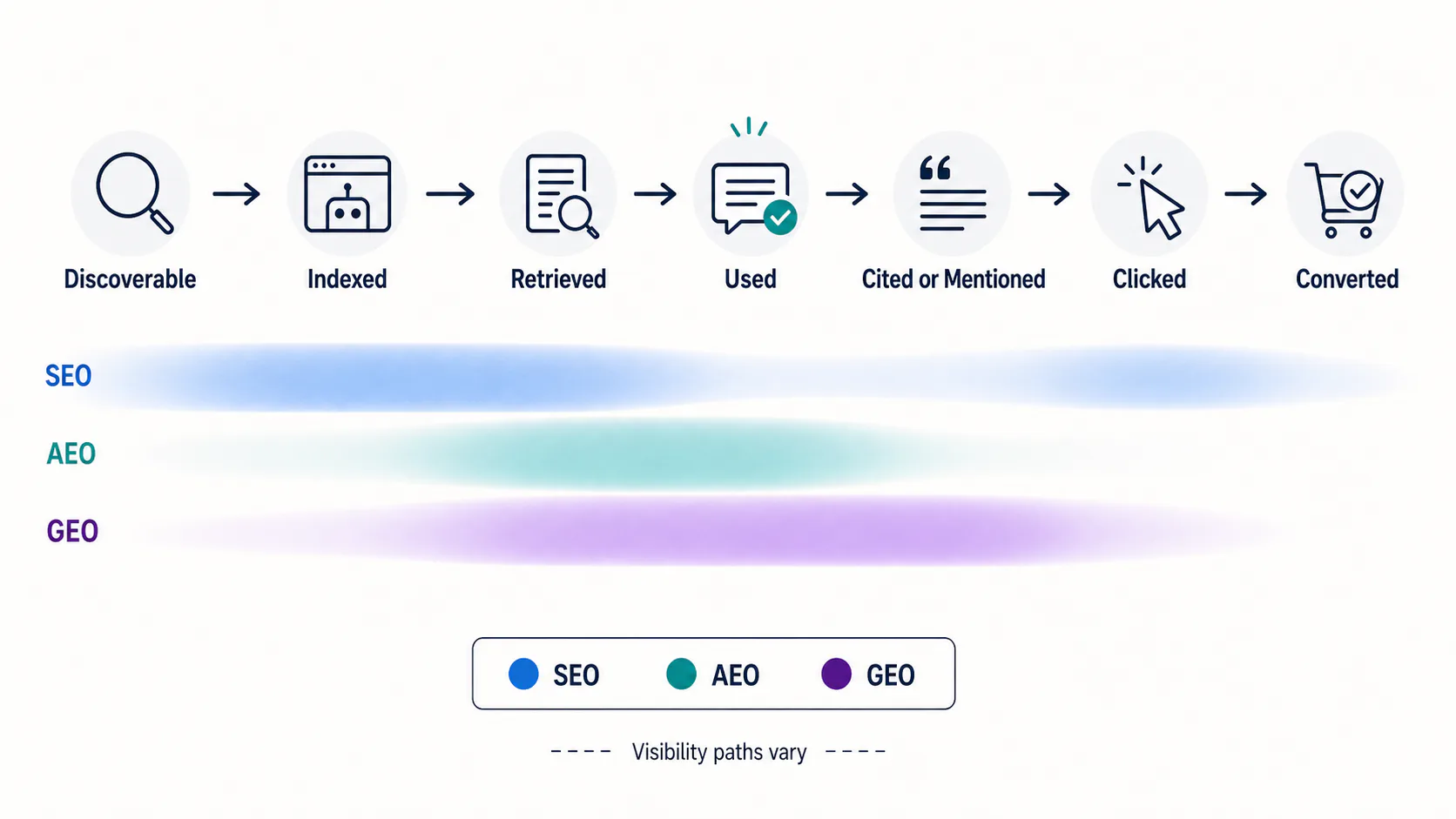
The practical model is one pipeline: discoverable → indexed → retrieved → used → cited or mentioned → clicked → converted. SEO, AEO and GEO emphasize different parts of that pipeline, while sharing much of the same technical and editorial foundation.
Disclosure: SEO Autopilot sells content-automation software. The definitions and recommendations below rely on external documentation and research. Automation by itself does not improve SEO, AEO or GEO performance.
First, a terminology warning
Search engine optimization is an established discipline. Answer engine optimization and generative engine optimization are newer practitioner labels with unsettled boundaries. Some publishers use AEO as an umbrella for all answer systems and place GEO beneath it. Others reserve AEO for direct answers and use GEO for synthesized responses. Comparing the current definitions used by [GeoCopy](https://www.geocopy.io/seo-vs-aeo-vs-geo) and [LetAEO](https://letaeo.com/blog/aeo-vs-seo-vs-geo) illustrates the disagreement.
Google takes a platform-specific position: its generative Search features rely on core Search ranking and quality systems, so Google considers optimization for those experiences to be SEO. This does not establish how ChatGPT, Copilot, Perplexity, Gemini or other systems should be categorized. [Google Search Central](https://developers.google.com/search/docs/fundamentals/ai-optimization-guide)
Working definitions: SEO is the organic-search and discovery foundation; AEO is the direct-answer lens; GEO is the generative retrieval, synthesis and representation lens. These are useful operating boundaries, not universal standards.
SEO, AEO and GEO at a glance
These columns describe emphasis, not exclusive ownership. Technical accessibility matters across all three. Clear answer passages can support both direct-answer and generative surfaces. Original evidence can make a page more useful to readers, earn links and give retrieval systems distinctive material to consider.
The meaningful differences are the event being observed and the outcome being measured. A ranking does not prove retrieval. A citation does not prove a click. A brand mention does not establish favorable representation or revenue.
| Dimension | SEO | AEO | GEO |
|---|---|---|---|
| Target surface | Ranked organic results and other search appearances | Featured snippets, voice responses and other direct-answer surfaces | Synthesized responses in generative search and assistant systems |
| Primary optimization unit | A page within a technically coherent site | An accurate answer passage supported by adequate context | Sources, passages, entities and corroborating evidence that may be retrieved and synthesized |
| Mechanism emphasized | Discovery, crawling, indexing, ranking and click selection | Answer extraction and selection | Retrieval, grounding, synthesis, citation, mention and recommendation |
| Desired outcome | Qualified organic visibility, visits and business results | Accurate answer inclusion and useful follow-on actions | Accurate representation, attribution, relevant referrals and business results |
| Typical metrics | Impressions, position, click-through rate, clicks and conversions | Answer appearance, accuracy, linked visits and conversions | Sampled citations, cited pages, mentions, representation, sentiment, referrals and conversions |
| Evidence and tooling | Mature documentation and established reporting | Surface-specific and sometimes observable only through repeated checks | Platform-dependent, probabilistic and still developing |
Run one query through the visibility pipeline
Suppose a publisher has a detailed checklist explaining how to verify claims, inspect sources, check originality, preserve brand voice, review links and metadata, and assign final approval to a human editor.
For SEO, the page must first be eligible and competitive in search. Its title and snippet then need to help the right searcher decide whether to click.
For AEO, a passage such as “Review factual claims, source quality, originality, brand fit, links and publication settings before a human editor approves the article” can answer the core question directly. The rest of the page should explain how to perform those checks and when additional review is necessary. Answerability does not require shallow content.
For GEO, a system may run related retrieval queries about fact-checking, editorial accountability and content quality, then synthesize information from several sources. A retrieved source may not be used; an apparent contribution may not be visibly cited; and a citation may not receive a visit. This is a hypothetical illustration, not an observed result from a particular platform.
| Pipeline stage | What could happen | Main emphasis |
|---|---|---|
| Discoverable and indexed | The page can be found, crawled and indexed; its canonical and internal links are coherent. | Primarily SEO |
| Retrieved | A system selects the page or passage for consideration in response to the initial query or a related retrieval query. | SEO and GEO |
| Used | Information from the source contributes to an extracted or synthesized answer. | AEO and GEO |
| Cited or mentioned | The system visibly attributes a page, names a brand or recommends an option. | Primarily GEO |
| Clicked | A user follows a ranked result, answer link or generative citation. | All three can contribute |
| Converted | The visit produces a lead, signup, purchase or another defined result. | Business measurement |
What traditional SEO still covers
SEO helps pages become discoverable, indexable, understandable, competitive and appealing in organic search. It includes technical configuration, site structure, search-intent research, on-page relevance, internal linking, content quality, reputation and link earning.
These foundations also affect eligibility farther down the pipeline. For Google’s generative Search features, a supporting page must be indexed and eligible to appear in Search with a snippet. Meeting those conditions does not guarantee crawling, indexing or inclusion. [Google Search Central](https://developers.google.com/search/docs/appearance/ai-features)
Conventional rankings remain commercially important because they can generate attributable visits when users need a full method, comparison, transaction or expert explanation. The goal is qualified discovery—not traffic at any cost.
Good rankings do not control downstream answer selection or citation. Query fan-out and passage-level retrieval can also expose sources that are not the highest-ranking results for the user’s initial wording.
- Discovery and indexation: crawler access, usable rendering, canonicalization, XML sitemaps and internal links.
- Relevance and usefulness: alignment with search intent, adequate depth and accurate terminology.
- Site architecture: logical relationships among guides, evidence, product pages and supporting resources.
- Reputation: legitimate editorial references, backlinks, reviews and coverage earned through useful work.
- Search presentation: titles and snippets that help qualified readers decide whether to visit.
- Performance: engagement and conversions from organic landing pages, not rankings in isolation.
What the AEO lens adds
Answer engine optimization asks whether a system can identify and present a dependable answer without reconstructing it from vague or scattered prose. Under this article’s working definition, the lens applies to featured snippets, question-led results, voice responses and similar direct-answer surfaces.
Implementation is primarily editorial: use descriptive headings, answer the question clearly, define ambiguous terms and follow the initial response with evidence, limits, examples or instructions. A simple factual question may need one sentence; a high-risk question may require qualifications before a recommendation is safe.
This does not justify placing a fixed-length answer capsule below every heading. Repetitive capsules can make writing mechanical and remove necessary context. Nor does every article need an FAQ if its main sections already answer the relevant questions.
Structured data can describe visible content and establish eligibility for supported rich results. It does not guarantee a featured snippet, direct-answer extraction or inclusion in a generated response. Google specifically says that no special schema is required for its generative Search features. [Google Search Central](https://developers.google.com/search/docs/fundamentals/ai-optimization-guide)
A useful answer passage is concise enough to understand quickly and complete enough to remain accurate. Its length should follow the question, not a universal word count.
What the GEO lens adds
Generative engine optimization examines what happens when a system retrieves sources, grounds a response and synthesizes a new answer. Some platforms may expand a prompt into several related searches. Google, for example, documents retrieval-augmented generation and query fan-out for its own generative Search features. [Google Search Central](https://developers.google.com/search/docs/fundamentals/ai-optimization-guide)
This creates more possible outcomes than a conventional rank. A citation may appear among several links yet attract little attention. A brand may be named without its website being cited, or recommended only for a narrow use case. From outside the system, it may be impossible to determine every source that influenced an uncited statement.
Original research, first-hand experience, precise facts, primary-source support and consistent entity information can make content more useful and less ambiguous. Legitimate independent coverage can corroborate claims. These are sound editorial and reputation investments, but the evidence does not establish them as universal citation factors across platforms.
Generative visibility varies with the platform, prompt, locale, model, personalization and time. A July 2026 critical-survey preprint describes GEO as a stochastic, partly observable pipeline rather than a stable ranking task. Because that survey has not been presented here as peer-reviewed evidence, its conclusions should be treated as a research synthesis rather than platform policy. [Critical GEO survey](https://arxiv.org/abs/2607.14035)
- Retrieval: was the source selected for consideration?
- Use: is there evidence that its information contributed to the response?
- Citation: was a page visibly attributed?
- Mention: was the organization or product named, with or without a link?
- Recommendation: was it presented as suitable, and under what conditions?
- Referral: did a user follow a link?
- Conversion: did the visit produce a useful business result?
Where the work overlaps—and where it genuinely diverges
The greatest overlap lies in publishing useful, accessible and maintainable information: organize pages clearly, support consequential claims, identify accountable authors, correct errors and update material when circumstances change.
The divergence begins with the unit of success. SEO commonly evaluates pages and organic visits. AEO examines whether a direct answer was accurately selected and displayed. GEO may assess pages, passages and entities across many variable responses. Three duplicate editorial programs would waste the shared foundation; one blended “visibility score” would hide meaningful differences.
- A page can rank prominently yet never be cited in a synthesized response.
- A page can be cited while other pages rank above it for the initial query.
- A brand can be mentioned without a source link, referral visit or conversion.
| Area | Shared investment | Where emphasis differs |
|---|---|---|
| Technical accessibility | Crawlable, renderable pages; intentional indexing; coherent canonicals and internal discovery | Foundational across all three |
| Editorial value | Accurate, useful, non-commodity information with first-hand evidence where available | SEO emphasizes page usefulness; AEO answerability; GEO retrieval and representation |
| Structure | Descriptive headings, readable sections, clear definitions and adequate context | AEO focuses most directly on self-contained answer passages |
| Evidence | Primary sources, transparent methods, accountable authors or reviewers, and visible updates | GEO adds questions about corroboration and representation across sources |
| Search performance | Eligibility, relevance, result presentation, rankings, clicks and landing-page outcomes | Primarily SEO |
| Generated-answer performance | Retrieval, citations, mentions, recommendations, representation and referrals | Primarily GEO |
Official guidance versus industry hypothesis
Google’s current guidance says that publishers do not need special AI files, tiny content chunks, AI-specific rewrites or special schema for Google Search. It also warns against scaled pages created mainly to manipulate conventional or generative results. [Google Search Central](https://developers.google.com/search/docs/fundamentals/ai-optimization-guide)
The original GEO research, accepted at KDD 2024, reported visibility improvements of up to 40% under its tested conditions. The later critical-survey preprint argues that the test assumed sources were already present in a fixed context and therefore did not demonstrate durable organic discovery or downstream traffic on live platforms. [Original GEO paper](https://arxiv.org/abs/2311.09735), [critical survey](https://arxiv.org/abs/2607.14035)
Use an evidence ladder: first-party documentation for platform controls and eligibility; peer-reviewed research for bounded findings; controlled tests for platform- and date-specific observations; vendor datasets as leads to investigate; and clearly labeled hypotheses for unverified causal explanations. Google likewise recommends checking third-party claims against official guidance. [Google’s third-party SEO guidance](https://developers.google.com/search/docs/fundamentals/third-party-seo)
| Evidence level | What it supports | Responsible conclusion |
|---|---|---|
| Official Google guidance | Normal Search eligibility and core SEO practices remain relevant to AI Overviews and AI Mode; inclusion is not guaranteed. | Keep technical SEO and useful content as the foundation. |
| Official Google guidance | Google Search does not use llms.txt and does not require AI-specific markup, mandatory chunking, AI-only rewrites or special schema. | Do not add maintenance work without a demonstrated platform or user benefit. |
| Established Search capability | Appropriate structured data can support supported rich-result eligibility when it matches visible content. | Implement it for documented uses, not as a citation promise. |
| Industry hypothesis | Fixed passage lengths, universal answer capsules, citation formulas and causal effects from unlinked mentions. | Test by platform and label results as observations, not rules. |
| Bounded research result | The foundational GEO study reported visibility gains of up to 40% in its experimental setting. | Do not convert the finding into a promise of discovery, traffic or revenue. |
Measure the outcome you actually want
For organic search, interpret established metrics together. Position without impressions may mean little exposure. Impressions without clicks may reveal an intent or presentation problem. Clicks without qualified engagement or conversion may indicate that the page attracts the wrong audience.
Direct-answer reporting is less consistent. Record whether the answer appeared, whether it was accurate, whether a link was available and whether resulting visits produced value. Do not count a zero-click appearance as an automatic commercial win.
Bing Webmaster Tools’ AI Performance public preview reports citations, cited pages, sampled grounding queries and trends across supported Microsoft and partner experiences. Microsoft states that its citation figures do not indicate placement, page importance or authority. [Bing Webmaster Blog](https://blogs.bing.com/webmaster/February-2026/Introducing-AI-Performance-in-Bing-Webmaster-Tools-Public-Preview)
Google now directs publishers to a Generative AI performance report in Search Console for its own generative features. This is a material change from older guidance that described AI-feature traffic only as part of aggregate Web reporting, so use the current documentation when designing dashboards. [Google Search Central](https://developers.google.com/search/docs/fundamentals/ai-optimization-guide)
When dependable first-party reporting is unavailable, repeated prompt samples can indicate trends. Record the platform or experience, exact prompt, locale, date and number of runs. Test several realistic formulations and treat the results as a sample distribution, not a fixed ranking.
Finally, connect visibility to business outcomes. A citation may have awareness value without a click, but citation volume alone cannot prove favorable representation, qualified demand or revenue.
| Outcome group | Report separately | Possible evidence |
|---|---|---|
| SEO | Organic impressions, average position, click-through rate, clicks, landing-page engagement and conversions | Search Console, Bing Webmaster Tools and web analytics |
| AEO | Direct-answer appearance, answer accuracy, visible links, associated visits and conversions | Surface checks, available search reporting and analytics |
| GEO | Citation frequency, cited pages, sampled grounding queries, mentions, representation or sentiment, referrals and conversions | Available platform reports, analytics and repeated prompt samples |
| Business outcome | Qualified leads, purchases, subscriptions, revenue or another defined conversion | Analytics, CRM and commerce systems |
A citation is not a rank. A mention is not a referral. A referral is not a conversion.
Crawler controls: visibility is not the same as model training
Crawling, indexing, snippet eligibility, AI-search discovery and potential model-training permission are separate concepts. Treating them as one switch can remove useful visibility or fail to express the publisher’s actual preference.
For Google Search, Googlebot access and ordinary Search controls govern participation in AI Overviews and AI Mode. Google documents nosnippet, data-nosnippet, max-snippet and noindex as ways to restrict how page content appears or is used. [Google Search Central](https://developers.google.com/search/docs/appearance/ai-features)
OpenAI distinguishes OAI-SearchBot, used for ChatGPT search discovery, from GPTBot, which publishers can disallow for pages they want excluded from potential training. OpenAI also says ChatGPT referral links include `utm_source=chatgpt.com`, providing an analytics signal for visits. [OpenAI publisher FAQ](https://help.openai.com/en/articles/12627856-publishers-and-developers-faq)
Crawler names and controls vary by platform. Check current first-party documentation before modifying robots.txt or page-level directives, and confirm that any crawler expected to obey a meta directive can access the page to read it.
| Publisher intention | Relevant control | Important distinction |
|---|---|---|
| Participate in Google Search, including AI Overviews and AI Mode | Allow appropriate Googlebot crawling and preserve indexing and snippet eligibility | Google documents no separate Search crawler requirement for these features. |
| Limit content displayed or used in Google Search features | Use supported controls such as nosnippet, data-nosnippet, max-snippet or noindex according to the intended outcome | These controls have different effects and can limit generative-feature eligibility or use. |
| Allow content in ChatGPT search summaries and snippets | Do not block OAI-SearchBot | OpenAI identifies OAI-SearchBot as its search-discovery crawler. |
| Exclude pages from potential OpenAI training | Disallow GPTBot where appropriate | This preference is separate from OAI-SearchBot access for ChatGPT search. |
| Ensure a noindex directive can be read | Allow the relevant crawler to access the page long enough to see the directive | A robots.txt block may prevent a crawler from reading page-level metadata. |
A practical operating model for a small team
Most compact teams do not need three departments or three content calendars. They need one coordinated search-visibility program with shared production standards and surface-specific measurement.
The sequence matters. Formatting cannot rescue a page that systems cannot access. Clear prose cannot make recycled information distinctive. Citation monitoring cannot demonstrate business value unless referrals and conversions are also assessed. Build from eligibility toward original evidence, comprehension, credibility and measurement.
Human review remains essential wherever accuracy, legal exposure, reputation or customer decisions are involved. Automation can support research and publishing operations, but it cannot establish expertise, validate a claim or guarantee visibility.
- Secure technical eligibility. Check crawlability, indexability, canonical targets, rendering, internal discovery and snippet controls.
- Publish non-commodity information. Add first-hand experience, original data, worked examples or expert analysis that a generic summary cannot replace.
- Improve answerability. Use descriptive headings, precise definitions and concise answers followed by the context needed for accuracy.
- Strengthen credibility and consistency. Cite primary sources, identify authors or reviewers, document methods and keep core facts consistent across legitimate profiles and references.
- Separate reporting. Maintain distinct views for organic results, direct answers, generative citations or mentions, referrals and conversions.
- Run controlled tests. Change one meaningful element, record the platform and date, sample repeated outputs and retain negative or inconclusive results.
- Review by locale. Localize evidence and entity facts, test native-language prompts and avoid assuming English-language behavior transfers unchanged.
- Assign one accountable owner. Add specialist roles only when publishing scale, platform exposure or measurement complexity justifies them.
Keep SEO as the foundation, use AEO to improve answerability, and use GEO to examine retrieval and representation in generative systems.
SEO, AEO and GEO are best understood as overlapping lenses on one visibility pipeline. SEO establishes discovery, eligibility and organic performance. AEO focuses on clear, dependable answers. GEO extends the analysis to retrieval, synthesis, citations, mentions and representation in generative systems. Use one evidence-rich publishing program, but keep platform controls, outcome metrics and causal claims separate.
Review one important page against the pipeline: can systems discover it, understand it, extract an accurate answer, verify its claims and attribute the source—and can you measure what happens next?