Evaluate agency SEO automation software by the failures it prevents, including mixed client context, weak approvals, silent publishing errors and hidden operating costs.
The SEO automation features that matter most to an agency are rarely the most impressive parts of a demo. The decisive controls keep client contexts separate, block unauthorized publication, expose integration failures, preserve editorial quality and make costs predictable at realistic volume. First identify which part of delivery needs automation. Then test the software across a complete client cycle.
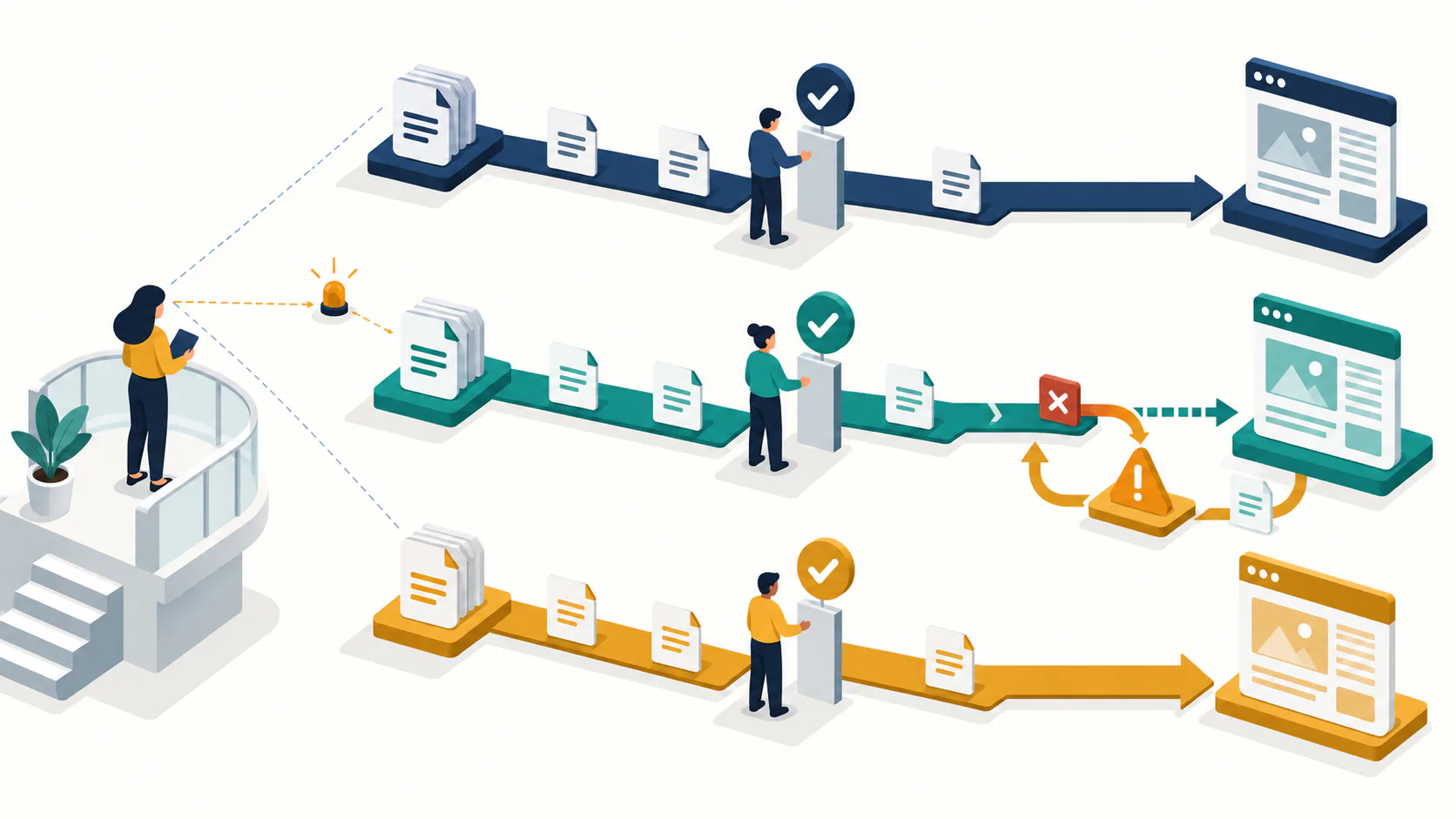
The expensive failure usually appears after the demo
Consider a hypothetical ten-client agency. A platform generates an article in minutes and assembles an attractive report, so the agency signs an annual contract. During onboarding, the team discovers that brand instructions are held in a shared library, reviewers cannot prevent direct publication and failed CMS jobs leave no actionable retry history.
The mistake was not choosing a slow tool. It was buying visible output without testing operational risk.
The goal is to increase delivery capacity while preserving client separation, editorial acceptance, accountability and margin. Achieving that requires three steps: identify the actual bottleneck, classify the necessary controls and make each shortlisted vendor prove its claims in a representative pilot.
Evidence checked on September 13, 2026. Recheck plans, limits, integrations and security documentation before purchasing; software packaging can change materially.
First decide which job needs automation
“SEO automation software” covers several product categories. A reporting platform may automate monthly dashboards without creating content. A content platform may research and publish articles without replacing technical crawling or rank tracking. These products should not be scored as though they perform the same job.
Map the current process, handoffs and recurring exceptions. The purchase should produce one of three outcomes: replace an existing tool and its associated work, add a specialized execution layer, or keep the current stack because the candidate only duplicates capability.
Separate task automation from autonomous execution as well. Automation performs a defined step. Autonomy lets software choose or perform subsequent steps without a person initiating each one. Autonomy is a permission level, not evidence of broader SEO coverage.
| Automation job | Typical inputs | Typical outputs | Human decision that remains | Failure to investigate |
|---|---|---|---|---|
| Research and planning | Site inventory, search data, competitor pages and client strategy | Topic maps, briefs and priorities | Which opportunities fit the business and existing coverage? | Stale inputs, unexplained recommendations or overlapping pages |
| Technical monitoring | Crawl data, templates, logs and Search Console signals | Issues, alerts and assignments | Which finding is real, material and worth fixing first? | False positives, alert fatigue or unsupported recommendations |
| Content production | Approved brief, sources, brand rules and product knowledge | Drafts, metadata, images and revisions | Is the work accurate, useful and safe to approve? | Invented claims, generic copy, excessive editing or mixed client context |
| CMS publishing | Approved assets, field mapping, credentials and schedule | A correct draft or live page on the intended property | What may be published, where and by whom? | Wrong destination, missing fields, duplicates or silent authentication failure |
| Client reporting | Search, analytics, conversion, technical and delivery data | Dashboards, reports, annotations and alerts | What changed, why does it matter and what happens next? | Metric dumps, mixed accounts or activity presented as business impact |
Classify features before scoring them
A flat checklist rewards the longest product page. A classified matrix distinguishes safeguards from capabilities that may be irrelevant to your service model.
A capability is not verified because a salesperson displays its label. Ask for evidence that reveals its scope: a permission matrix, failed-job history, usable export, field-level integration documentation or applicable contractual terms.
| Class | Feature | Failure prevented | Evidence to request | Pilot test | When optional |
|---|---|---|---|---|---|
| Table stake | Separated client contexts and publishing destinations | Cross-client disclosure or publication | Workspace model, data-boundary documentation and a live two-client demonstration | Search for Client A material as a Client B user; attempt to select A’s destination | Optional only when the tool receives no client-specific data or credentials |
| Table stake | Client- and action-level permissions | Unauthorized viewing, editing, exporting or publishing | Permission matrix and sample role configuration | Assign different user roles and attempt prohibited actions | Rarely optional for multi-user agency work |
| Table stake | Approval gates and draft-only mode | Unreviewed work reaching production | Workflow documentation and approval-state history | Try to publish an unapproved draft with a restricted user | Optional for tools that cannot alter client properties |
| Table stake | Activity and publishing logs | Untraceable changes and silent failures | A log showing actor, time, action, object and result | Create, revise, approve, fail and retry a job; check every event | Not optional when the system can edit or publish |
| Table stake | Exports and failure recovery | Vendor lock-in or lost work | Sample bulk export and recovery documentation | Export a complete project; revoke CMS access, restore it and retry | Not optional for production workflows |
| Service-dependent | Content generation and inventory awareness | Low-value drafts or cannibalization | Source handling, brief controls and existing-page analysis | Process a representative brief through the normal editorial gate | Optional for technical or reporting-only agencies |
| Service-dependent | Crawling, rank, local or AI-search monitoring | Missing necessary coverage or paying for irrelevant coverage | Data sources, geography, methodology and refresh cadence | Compare a sample with the current process and investigate differences | Required only for services the agency sells |
| Service-dependent | Multilingual review and locale controls | Unsafe localization or mixed-language instructions | Locale-specific configuration and reviewer workflow | Run one topic through two locales with different rules and approvers | Optional for monolingual client books |
| Procurement-dependent | SSO, attestations, retention or residency controls | Failed procurement or contractual non-compliance | Current documentation, attestation scope and contractual terms | Route the evidence through the agency’s applicable procurement process | Depends on contracts, jurisdiction, industry and data sensitivity |
Test whether client separation is real
“Multiple projects” may mean folders inside a shared account. Real separation covers brand guidance, sources, strategies, credentials, destinations, reports and access rights.
Test the boundary from both directions: what an authorized user can reach and what an unauthorized user is prevented from reaching. Use dummy data and non-production destinations. A portfolio-dashboard screenshot does not prove enforcement.
- Create two dummy clients with conflicting brand rules, prohibited terminology, source libraries and publishing destinations.
- Copy the same reusable workflow between them. Inspect the copied template for client-specific instructions, excerpts, URLs and destination settings.
- Create strategist, writer, reviewer, client and publisher users. Confirm what each role can view, edit, approve, export and publish.
- Attempt prohibited actions. Test direct links, copied tasks, shared assets and exports—not only navigation-menu visibility.
- Remove a user and revoke a CMS connection. Confirm that access disappears and that both events appear in the activity history.
- Export one dummy client and inspect whether content, metadata, briefs and relevant history remain intelligible outside the platform.
White-label styling is not access control. A custom logo, domain or report theme does nothing by itself to prevent cross-client exposure.
Measure editorial value at the approval gate
Generation speed matters only when the output survives review. Inspect source provenance, client-specific instructions, version history, change attribution, rollback and the ability to block publication until the required approval is recorded.
Give reviewers a concrete usefulness test. The information-gain framework explains how to map existing coverage, define a new contribution and verify it at claim level.
Google says generative AI can assist research and content structure, but warns that generating many pages without adding value may violate its scaled-content-abuse policy. Its guidance also emphasizes accuracy, quality and relevance. Editorial acceptance and added value are therefore more defensible buying criteria than article volume. Read Google Search Central’s guidance. Compliance does not guarantee indexing or rankings.
| Measure | Calculation | What it reveals | Measurement note |
|---|---|---|---|
| Recommendation acceptance | Accepted recommendations ÷ reviewed recommendations | Whether automated planning produces work strategists would commission | Record rejection reasons: wrong intent, duplication, weak evidence or low business value |
| Editing effort | Active research, correction and editing minutes before approval | Whether generation removes labor or moves it downstream | Measure by client and content type; report the median and important outliers |
| First-pass approval | Drafts approved without a substantive rewrite ÷ drafts reviewed | How consistently the system follows the brief and client rules | Define “substantive rewrite” before testing |
| Approval-cycle time | Elapsed time from submission to final approval | Whether the workflow reduces or adds handoffs | Separate active review from waiting time |
| Cost per approved deliverable | Total allocated software and production labor ÷ accepted outputs | The economically useful unit rather than price per generated article | Include research, editing, review and exception handling |
| Rejection profile | Count of failed editorial checks by category | Where the system or workflow needs correction | Separate factual, legal, brand, originality, intent and formatting failures |
Crash-test the publishing integration
Hypothetical test assumptions: a WordPress staging site, one custom metadata field, a revocable credential and a user restricted to draft-only publishing. This is a test design, not a claim about a particular vendor or connector.
A CMS logo confirms neither field coverage nor production reliability. Test the entire handoff, including validation and recovery. Keep direct-to-production access disabled unless the agency has separately justified and controlled it.
Publication is also distinct from search performance. A page may exist in the CMS without being discovered, indexed or ranked. Use the crawling, indexing and ranking framework when visibility fails instead of treating a successful publish as proof of search success.
- Map title, slug, author, category, body, meta title, meta description, canonical configuration, internal links, featured image and the custom field before publishing.
- Send an approved item to the staging site as a draft. Compare every received field with the mapping specification and confirm that no production URL became public.
- Revoke the credential before a second job. Verify that the failure is visible, alerts the correct owner and records an actionable authentication error.
- Restore access and retry once. Confirm that recovery creates no duplicate draft, media item or slug.
- Submit an invalid custom-field value. Check whether the connector blocks the job, reports the omitted field or silently publishes incomplete content.
- Export the article and metadata, then run the documented recovery procedure. Record any step that depends on vendor support.
Pass only if the authorized draft reaches the correct staging property with complete field mapping, revoked access creates a visible and attributable failure, recovery creates no duplicate, and the content remains exportable.
Reporting should explain outcomes, not decorate activity
A useful client report connects completed work with visibility, organic visits, conversions and technical conditions. It preserves dated context and leaves room for an accountable person to explain what the data can and cannot establish.
White labeling may extend beyond a PDF logo, but it remains separate from access control. AgencyAnalytics currently documents logos, colors, client-specific profiles, custom domains and branded sender addresses, with some capabilities restricted to selected plans. See its white-label documentation. SE Ranking documents white-label options, up to ten restricted client seats and scheduled reports in an Agency Pack sold separately with eligible annual subscriptions. See its Agency Pack documentation. These are examples of evaluation dimensions, not endorsements or universal requirements.
Treat AI-search reporting cautiously. Proprietary visibility scores are not interchangeable unless engines, prompts, locales, sampling and cadence are sufficiently comparable. First determine whether this measurement belongs in your service offer; the guide to SEO, GEO and AEO clarifies the disciplines and their overlap.
| Dimension | Inspect | Decision question |
|---|---|---|
| Data coverage | Rankings, Search Console, analytics, conversions, technical health and delivered work where relevant | Does the report distinguish activity from outcomes and expose missing data? |
| Explanation | Dated annotations, comparison periods and editable commentary | Can the account lead explain what changed, the likely causes, confidence and next action? |
| Access | Read-only client role and client-level restrictions | Can clients inspect their data without seeing other accounts or changing configuration? |
| Delivery | Schedule, recipients, approval status and failure notification | Will the team know when a report is stale, incomplete or undelivered? |
| Branding | Report styling, sender identity, portal domain and client-specific profiles | Which elements are configurable, and which require another plan or add-on? |
| Portfolio monitoring | Cross-client alerts with account-level drill-down | Can operations find exceptions without blending client data? |
| AI-search measurement | Engines, prompts, locales, sampling, cadence and repeated-run variance | Can the method be reproduced, and are citations, mentions and rankings separated? |
Add procurement depth only when the client book requires it
A boutique agency publishing low-risk drafts may not need the same procurement package as an agency handling regulated content or enterprise credentials. The difference is the depth of evidence required, not permission to ignore security.
Translate the client book into operational questions: whose data enters the system, which properties it can change, who can authorize those changes, how access is revoked and what each relevant contract requires.
- How CMS and analytics credentials are authorized, stored and revoked
- Whether multi-factor authentication is available and how privileged access is controlled
- Which content, permission and publishing events are recorded
- Data-retention and deletion procedures, including treatment of backups
- Current subprocessor information and incident-notification procedures
- Availability and scope of a data processing agreement
- Any contract-specific requirement for SSO, attestations, data residency or support commitments
Security and privacy requirements depend on client contracts, jurisdiction, industry and the data processed. Treat certifications and GDPR-related statements as claims requiring current documentation, not as legal conclusions.
The right shortlist changes with the agency model
There is no defensible universal winner. Content agencies need high editorial acceptance; technical consultancies need trustworthy diagnostics; ecommerce agencies cannot treat field mapping and recovery as minor integration details.
An all-in-one platform is useful only when its breadth removes real work without weakening control or specialist depth. Otherwise, a smaller stack with explicit ownership at each handoff is easier to test and govern.
| Agency model | Prioritize | Often optional | When a specialist stack is preferable |
|---|---|---|---|
| Content-led | Inventory awareness, source handling, brand rules, editorial efficiency, approval flow and draft publishing | Enterprise identity controls not required by clients | Keep existing technical and reporting tools when a focused content layer achieves better acceptance |
| Technical SEO | Crawl scale, explainable diagnostics, alert quality, assignment and false-positive rate | Article generation | Retain specialist crawling or monitoring when a broad suite loses diagnostic depth |
| Ecommerce | Store separation, template and field coverage, staging, destination restrictions and recovery | Blog-volume features that ignore product and category constraints | Use CMS-specific execution with separate monitoring if one system cannot handle the store safely |
| Multilingual or regulated | Locale-specific rules, qualified reviewers, strong sources, granular permissions and longer approvals | Direct publishing without explicit authorization | Prefer modular tools when controls must differ by locale or risk class |
| Reporting-led | Reliable connections, isolated read-only access, annotations, delivery controls and suitable branding | Content creation when production occurs elsewhere | Add a reporting layer instead of duplicating production and technical systems |
| Full-service | Clear boundaries across research, technical work, content, publishing and reporting | Duplicated features that create another source of truth | A connected specialist stack may be safer when ownership at each handoff remains clear |
Calculate the cost the pricing page does not show
Headline subscriptions omit many costs that determine agency margin. Build the model from units that grow with the roster and from labor observed during the pilot.
For a current example, SEO Autopilot’s public pricing lists 4, 12 and 30 monthly articles with limits of 1, 3 and 10 projects. It also lists automatic publishing, scheduling and a content calendar. That page does not document agency-grade roles, approval stages, audit logs, white-label reporting or security certifications, so do not assume those controls are included. Review the current pricing page.
Recheck packaging before signing. Semrush’s current first-party notice, for example, says its former Agency Growth Kit was discontinued and its Client Portal and CRM were sunset. Read the sunsetting notice.
- Cost per client = total monthly software, add-on and labor cost ÷ active clients using the system.
- Cost per approved deliverable = (allocated software cost + research labor + editing labor + review labor + exception-handling labor) ÷ accepted deliverables.
- Cost per successfully published deliverable = (approved-deliverable cost + publishing supervision + recovery and cleanup labor) ÷ outputs that reached the correct destination intact.
| Cost layer | Include | How to evaluate it |
|---|---|---|
| Capacity | Manager and client seats; projects or domains; tracked keywords; crawl pages; article or word credits; API calls and storage | Model the expected roster plus ordinary peaks, not only the launch configuration |
| Packaging | Required plan, agency add-ons, annual commitments and overages | Price the complete configuration needed for permissions, exports and delivery |
| Onboarding | Account setup, templates, migration, connections and field mapping | Record internal labor and paid implementation support |
| Production | Research, editing, review, approval and exception handling | Use staff time measured during the pilot |
| Failure handling | Disconnected integrations, malformed data, retries, duplicate cleanup and support | Estimate from observed incidents rather than assuming zero failures |
| Reporting | Data cleanup, annotations, client questions and delivery checks | Subtract only the hours the candidate demonstrably removes |
| Exit | Exports, format conversion, historical data, migration and credential revocation | Test a sample export before purchase |
An advertised cost per generated article and your cost per approved, successfully published article measure different things.
Run a full-cycle pilot before buying
A demo proves that a prepared workflow can succeed. A pilot shows whether ordinary staff can operate the system across representative clients when permissions, data and integrations fail.
Cover one complete delivery cycle. A short content-generation test cannot reveal month-end reporting friction, recurring approvals, realistic credit consumption or the cost of recovering publication failures.
- Choose two or three representative accounts: one straightforward client, one technically complex or unusual-CMS client and, where relevant, one multilingual, regulated or approval-heavy client.
- Record the baseline for one normal delivery cycle: people, active labor, waiting time, accepted outputs, publishing incidents, reporting work and software allocation.
- Configure the candidate with dummy or safely scoped data first. Record every workaround required during onboarding.
- Run normal work across research, review, client approval, publishing, measurement and reporting. Do not substitute an isolated generation contest.
- Test denied permissions, incorrect field mapping, revoked authentication, retry behavior, duplicate prevention, activity history, export and recovery.
- Compare results with thresholds set before the pilot. Do not redefine success after seeing the results.
- Forecast the expected roster, including seats, projects, credits, add-ons and overages.
- Record a replace, add or reject decision, the supporting evidence and any risk accepted by the agency.
| Measure | Definition | Threshold approach | Evidence |
|---|---|---|---|
| Onboarding time | Hours from an empty account to a usable client workflow | Set a maximum from the current baseline | Time log and completed setup checklist |
| Recommendation acceptance | Accepted recommendations ÷ reviewed recommendations | Set by service and client type before testing | Decision log with rejection reasons |
| Editing effort | Median active editing minutes per draft plus material outliers | Must improve sufficiently to cover migration and supervision | Time records and issue categories |
| Approval-cycle time | Elapsed and active time from submission to approval | No longer than baseline unless extra control is an intentional benefit | Workflow timestamps |
| Publishing reliability | Failures, silent failures and duplicates per attempt | Zero silent failures, unexplained duplicates and unauthorized production changes | CMS records, alerts and logs |
| Reporting labor | Hours needed to validate, annotate and deliver a report | Lower than baseline without reducing explanatory quality | Time record and approved report |
| Permission enforcement | Results of denied-action and cross-client tests | No cross-client exposure or successful prohibited action | Access-test record and activity history |
| Export completeness | Required content, metadata, briefs, reports and history recovered | All operationally required data present and readable | Export inspected outside the platform |
| Unit economics | Complete cost per client and accepted output | Within margin requirements at pilot and forecast volumes | Cost model with assumptions and sensitivity case |
Automatic disqualifiers should include cross-client exposure, an unauthorized production change, an unlogged material action, unrecoverable required data or repeated silent publishing failure. Other thresholds should reflect the agency’s baseline, margin and client obligations.
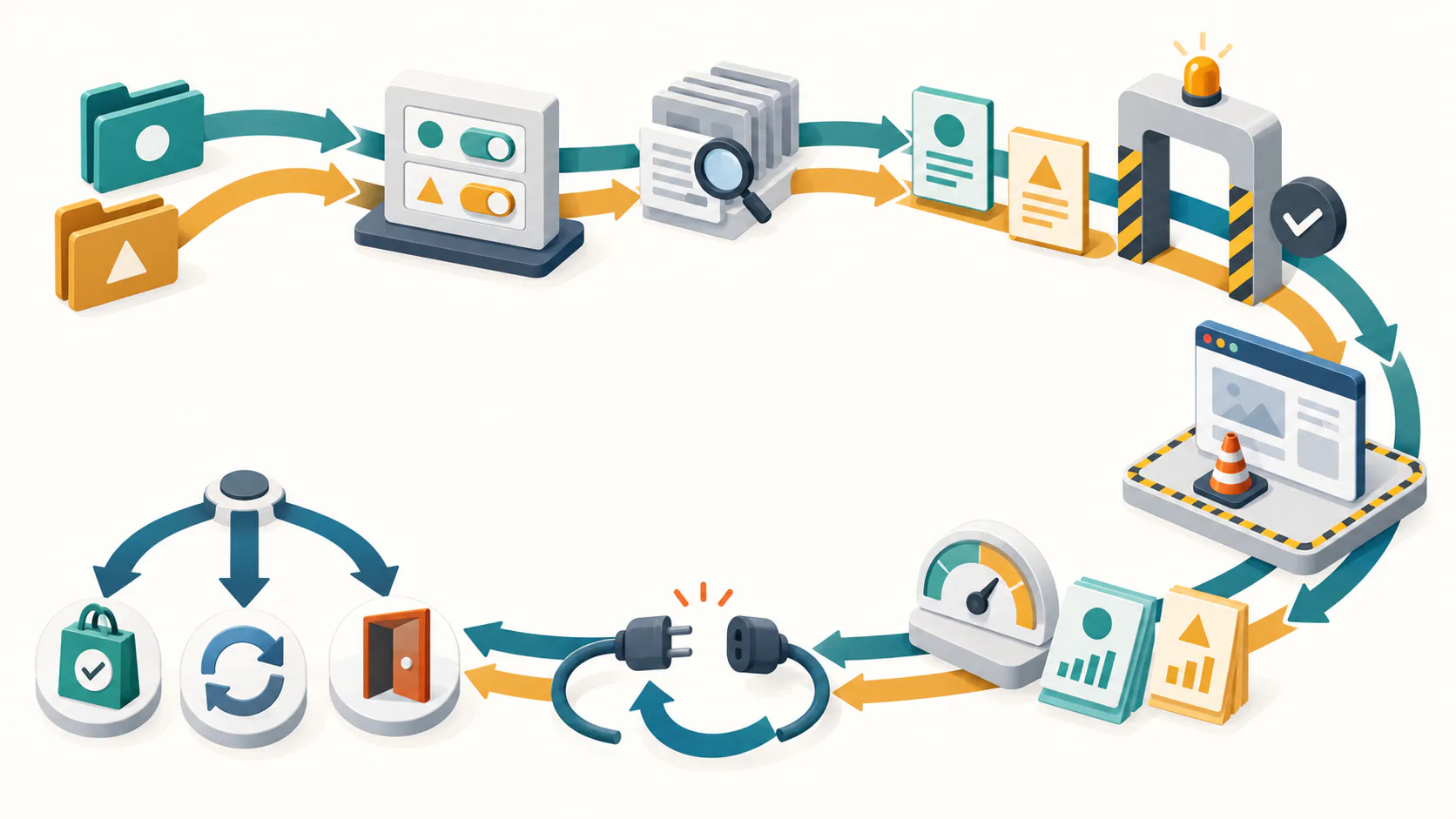
Choose: replace, add or reject
Do not let unused features compensate for a failed non-negotiable. Attractive dashboards cannot offset cross-client exposure, and fast generation cannot compensate for an approval flow that fails to stop production publishing.
Equally, do not reject a focused product merely because it cannot replace the entire stack. A specialist automation layer may be the more economical option when its boundary is clear, its output is portable and the surrounding handoffs remain accountable.
- Replace: the candidate passes its thresholds, removes existing software or labor, preserves required controls and does not create a conflicting source of truth.
- Add: it materially improves one job while the current stack remains stronger elsewhere.
- Reject or postpone: editing and exception handling consume the saving, realistic volume breaks the economics, exports are inadequate or the vendor cannot demonstrate isolation and recovery.
The right agency SEO software removes a verified bottleneck without creating a more expensive operational risk.
Choosing SEO automation software for an agency is an operating-model decision, not a feature-count contest. Identify the constrained job, require controls proportionate to the client book, calculate costs from accepted and successfully delivered work, and test the candidate for a complete client cycle. The evidence should support one clear action: replace existing work, add a specialist layer or walk away.
Use the pilot matrix below as your vendor-demo scorecard. Give every shortlisted provider the same test accounts, evidence requests and pass/fail criteria, then decide only after one complete delivery cycle. For an example of a research-to-publication product category, explore SEO Autopilot and verify every agency-specific control separately.
Sources
- Google Search’s guidance on using generative AI content
- AgencyAnalytics white-label reports and dashboards
- SE Ranking Agency Pack overview
- Semrush Agency Growth Kit sunsetting notice
- SEO Autopilot pricing
- Information Gain in SEO: How to Create Content Worth Indexing
- Crawling vs Indexing vs Ranking: A Diagnostic Framework for SEO Teams
- SEO, GEO and AEO: What Each Discipline Covers—and Where They Overlap